God vs. Science
Finding my place on an arbitrary spectrum, with religion on one end and science on the other, felt entirely pointless. Besides, true scientific rigor, as I later learned from giants like the geneticist Dr. Francis Collins*, does not require a zero-probability assumption of a transcendent authority. However, it does require an open and imaginative mind – the very trait my classmate demonstrated by offering an innovative theory to explain the apparent contradiction within young Earth creationism.
Here is a dialogue between Richard Dawkins and Francis Collins:
Dawkins: “If ever there was a slamming of the door in the face of constructive investigation, it is the word miracle. To a medieval peasant, a radio would have seemed like a miracle. All kinds of things may happen which we by the lights of today’s science would classify as a miracle just as medieval science might a Boeing 747. Francis keeps saying things like ‘from the perspective of a believer.’ Once you buy into the position of faith, then suddenly you find yourself losing all of your natural skepticism and your scientific - really scientific credibility. I’m sorry to be so blunt.”
Collins: “Richard, I actually agree with the first part of what you said. But I would challenge the statement that my scientific instincts are any less rigorous than yours. The difference is that my presumption of the possibility of God and therefore the supernatural is not zero, and yours is.”
*The name of one of my favorite characters, Dr. Venollins, is a portmanteau of Craig Venter and Francis Collins. Dr. Collins famously led the Human Genome Project.
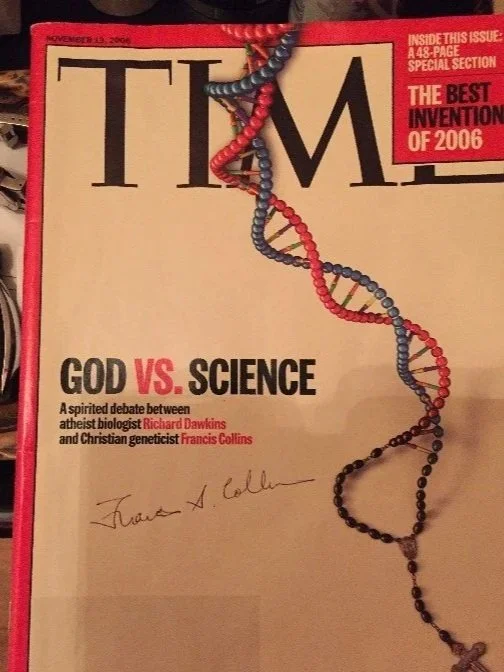
TIME: God vs. Science - Nov. 13, 2006
After signing a piece of my treasured memorabilia, Dr. Francis Collins turned to answer my burning question**:
‘I have no qualms about the existence of a deity, but I do question certain attributes of God. It’s easy to believe in a benevolent God in an air-conditioned room like this. But to me, God seems like an autistic child playing a video game.’
To my dismay, I cannot recall his response. Looking back, I suspect the pathway to my memory is obfuscated, because it either went over my head or failed to offer a logic I found compelling.
**This statement encapsulates how I feel about God and religion in general. Whether I consider myself Christian, an atheist, agnostic, or a disciple of Spinoza’s God isn’t all that pertinent to daily living. Enough people are busy placing others in buckets with superficial labels; for me, what matters is how we live.
It brings to my mind what Richard Feynman once noted about the difference between knowing the name of something and truly knowing it. Just because I can name a religion and profess that I am a believer doesn’t mean I understand its core teachings or more importantly, that I live by its underlying principles. What I find more interesting is how a person’s faith shapes their perception of reality and daily actions.

The uncomfortable truth is we are all hypocrites, as hypocrisy is not a binary trait; it’s just a matter of degree. Over the years, I’ve met plenty of hateful religious people, alongside egotistical secularists who mask their unwarranted condescension as scientific virtue. Once, after sharing my views on religion, a man told me, ‘My respect for you won’t diminish if you believe in God or decide to go to church.’ I wasn’t upset by his performative grace; rather, I felt disappointed with myself. Sometimes, the wisest thing to do is remain silent.
