Chapter 6
As soon as the lab manager switched off the magnetic levitation, Venollins could hear intermittent shrieks and howls reverberating throughout the entire room. Venollins felt goosebumps spreading over his tense body. He tried to retain composure but yelped when he heard a dull thud behind him. Venollins turned around and caught glimpses of a female bonobo who pressed her face against the bulletproof glass. Venollins instantly averted his eyes but couldn’t help redirecting his gaze at her humanlike face. The primate’s image and the reflection of his own face slowly morphed into a single entity, and asked a rhetorical question: What makes humans human?
The bonobo’s eyes were nervously inspecting the unfamiliar visitor.
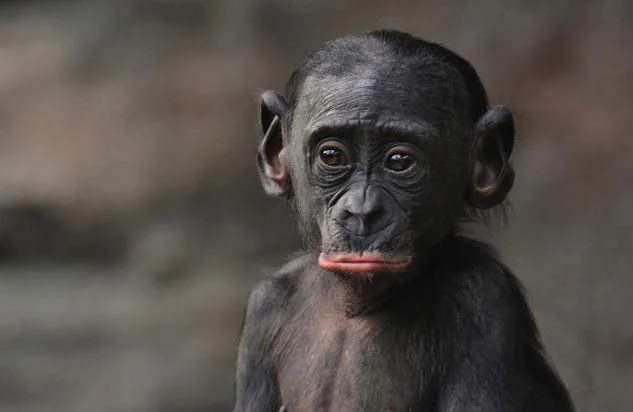
Is he a foe or friend? The ape seemed to ask, but her petrified facial expression signaled she had no friends at the facility.
Terror must transcend all modes of communication. The anthropomorphic images of the terrified bonobo drained blood from Venollins’ face and flooded his clenched jaws with acidic saliva with an elevated level of cortisol.
The bonobo returned his stare with a plea for common decency reserved for all living beings. Venollins wished he could tell the ape that she had nothing to fear, but he had no idea what side effects the animal would end up facing.
“Will they die?” Venollins immediately regretted asking the question.
“Some invariably will.” the lab manager said apathetically. “You will inoculate them with drugs to fight off the effects of rare pathogens and genetic deformities.”
The lab manager noticed the sudden change in Venollins’ behavior and sensed the inexpressible pathos in his spirit. She gently placed her hand on his left shoulder and tried to prevent Venollins’ discomfort turning into sullen despair.
“They look so human, don’t they? Sometimes I can’t help but wonder what they are thinking. I know you haven’t done animal testing with primates. Wait, have you?”
“Certainly not in this capacity.”
“I see. I recommend not getting emotionally attached to these test subjects.”
“Of course,” Venollins replied unconvincingly.
Venollins sensed bitter bile infiltrating his sense of morality. However, he knew far too well that it was a simple mental trick to distance himself from the doomed creatures. For millennia, humans have concocted moral narratives to bifurcate the livestock destined for slaughterhouses and their cherished house pets. Although he did not consider himself an avid animal lover, Venollins knew his new job was going to take an extreme toll on his mental and emotional health. There is no strict moral code; it’s all relative. Venollins asserted.
“Get ready for a surprise,” the lab manager said as if the primate housing facility did not adequately disturb Venollins’ sense of morality.
“Let’s hope for a positive surprise,” Venollins muttered.
the inspiration behind this text
Evaluating the atrocities of our ancestors* from the comfort of a moral judge’s seat is altogether self-righteous and convenient. Tempting as that position of power is, we stand to learn far more about our morality by stepping into the defendant’s dock of an inter-temporal criminal court. How, then, will our descendants judge us? With approximately 100 BILLION land animals farmed annually for meat, future generations may view our dietary choices and moral dissonance with the horror we reserve for the horrific institutional crimes our ancestors committed. This is not to say meat consumption is universally wrong; context matters. Choosing to eat meat when plentiful alternatives exist carries entirely different moral implications than doing so for survival. Furthermore, abstaining from consuming meat does not automatically grant moral righteousness.
As someone who loves brisket and fried chicken, I am not writing this from a place of virtue or authority; I am simply pointing out that causing animal suffering, given my current resources and alternatives, feels indefensible. I once told a vegetarian friend that I couldn’t wait for lab-grown meat to become widely available so I could finally enjoy it guilt-free. Yet, that confession didn’t sit well with me, as I sensed a deep contradiction in my superficial wish. True morality, after all, requires a willingness to bear a cost. The degree of personal cost an individual is willing to bear in pursuit of their ethical ambitions is a compelling metric for morality. As imperfect a measure as it may be, such willingness to expand our sphere of empathy beyond humans to other sentient beings is what inspired this chapter.
*yes, all our ancestors; it’s just a matter of how far we’re willing to go back.