We have failed him.
“Fern is wasting his life away,” Blue said.
Cut off here? Yes
I am targeting to have this novel finished by the end of 2027
“What is he doing this time?” Red asked.
“Discrete mathematics,” Yellowed chimed in.
“Seriously?” Green voiced their concern.
Caput Mortuum: A deep, historic brownish-purple or maroon once made from crushed mummies and iron residues.
Eburnean: A rich, milky off-white color that resembles high-quality elephant ivory.
Glaucous: A pale, muted grayish-blue or bluish-green shade found on the waxy coating of certain plant leaves and fruits.
Isabelline: A pale greyish-yellow or parchment color, famously used in ornithology to describe specific bird plumage.
Puce: A dark purplish-brown shade whose name literally translates from French as "flea".
Xanadu: A dusty, grayish-green hue named after the philodendron plant native to Australia.
Zaffre: A deep, intense blue pigment produced by roasting cobalt
Top Famous Irrational Numbers (not this)
Pi (\(\pi \approx 3.14159\)): The ratio of a circle's circumference to its diameter.
Euler's Number (\(e \approx 2.71828\)): The base of natural logarithms used in growth and interest calculations.
Golden Ratio (\(\phi \approx 1.61803\)): A special aesthetic proportion found frequently in geometry and nature.
Square Root of 2 (\(\sqrt{2} \approx 1.41421\)): The diagonal length of a square with sides of length one, historically the first proven irrational number.
Square Root of 3 (\(\sqrt{3} \approx 1.73205\)): Another common quadratic irrational arising from geometric triangles. [1, 2, 3, 4, 5, 6, 7, 8]
Oedipus eventually found refuge in a sacred grove in Colonus (near Athens), where the local King Theseus took pity on him and protected him. In the end, the gods transformed Oedipus into a tragic hero. Instead of dying a violent death, he was mysteriously carried away directly into the afterlife by the gods, and his final resting place became a blessed site meant to bring protection and good fortune to Athens.
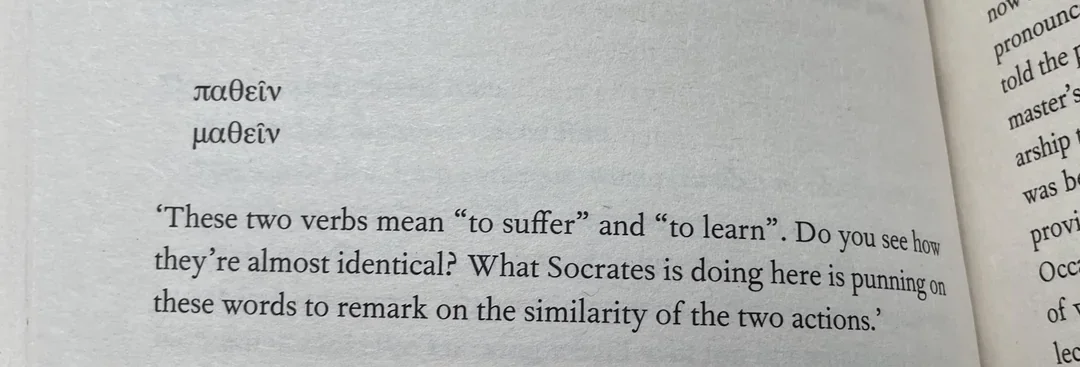
I saw this in Han Kang’s book ‘Greek Lessons’ (it’s fiction) and loved the similarity of the words.
3. Fate vs. Free Will
Throughout the myth, Oedipus is a puppet of destiny; Apollo and the gods orchestrated his tragic downfall before he was even born. However, the act of self-blinding is entirely his own choice.
When the chorus asks him what god drove him to slash his eyes, Oedipus responds that while Apollo brought about his radiant misery, “the hand that struck my eyes was mine and mine alone."
By blinding himself, Oedipus reclaims his agency and free will. He couldn't control his destiny, but he completely controls how he answers for it, transforming himself from a passive victim of fate into a active tragic hero.
4. Knowledge Comes with a Price
In Greek tragedy, there is a recurring concept that human beings can only achieve deep wisdom through immense suffering (pathei mathos). Oedipus’s self-blinding is the ultimate symbol of this cost. He wanted the truth at all costs, investigated aggressively, and solved the riddle of his own birth—but the truth was so blindingly horrific that it physically destroyed his ability to look at the world.